Friday, August 31, 2012

Crash of social IPOs

Facebook is trading at 18.03.  Compared to its initial price of $38, it's at less than half of its original value.  Zynga, social gaming powerhouse, is also trading at its fraction of IPO price.  Today Zynga ended at 2.80.  It has dropped about 70% from its original value.

Facebook ended its day at 18.06.
Facebook needs to focus on its customers,
and that means mobile and marketers

Thursday, August 30, 2012

What I discovered on the way to Bing Friends' Photo

It is hard to try something new.  When the tool that you use just works, there is no reason to pick up something new, invest time to learn quirks of the new tool, and get used to new experience.

That's the challenge that Bing has.  When Google just works, it's incredibly difficult to change people's behavior to switch to Bing.  Like everyone else, I see trying out a new tool as a chore.  Google just works, and I like Google's simple and functional UI that gives me confidence that things will just work.

So it's no surprise that I have not been using Bing for anything.  In fact, even on my IE 9 browser I changed my default search engine to Google.  But today the announcement of Friends' Photo feature gave me a reason to give Bing a try.

Wednesday, August 29, 2012

How many connected devices do you have?

Bloomberg ran an article about average U.S. household having five internet-connected devices.  That got me wondering about how many devices that I have in my family.  I have a young family with 3 year old and a month old.  My kids are not exactly at internet ready age (although my 3-year-old boy has proved to me that he's ready for e-commerce).  Yet our connected device count is nine.
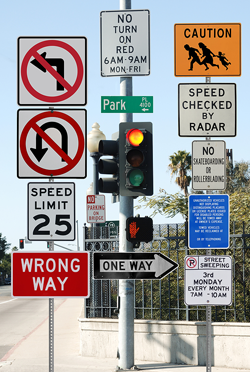
Whoa, what sign do I look first?
Information overload is just as bad as
lack of information.
We have two iPads, one Kindle Touch, one iPhone, three laptops, one mini PC and one desktop.  I actually think that we are below the Silicon Valley average because I'm the only one with smartphone.  I would guess most households would have each family member having one smartphone device and a laptop computer, and possibly one or two Wi-Fi-enabled tablets.  That would make 3-4 connected devices per adult, which would make 12 - 16 devices for a family of four.

What is surprising is how fast we got here.  A couple of years ago, the number of connected devices in my household was four.  We just had three laptops and one desktop.  Phones were simple feature phones or email-only Blackberry.  iPad and Kindle were not available on the market yet.

As I have posted earlier, we are at the cusp of transitioning to truly ubiquitous computing power and staying connected at all time.  We no longer wait for status of others.  We expect people to be available at all time.  We are expected to be available at all time.  This shift to constant connected-ness is creating not only technology paradigm shift, but also driving the shift of our perspectives of what it means to be reachable at all time.

No longer do we think about not having data.  It's about having relevant data at the right time to make decisions.  Delivering the right data at the right time and discovering new data are becoming more important than ever before.

How many connected devices do you have?  How do you keep up with deluge of information flooding your timeline everyday?

Tuesday, August 28, 2012

YouTube, the new global media

This morning when I turned on NPR, it was talking about new trends on popular YouTube content.  Among the examples cited, the first example was a K-pop sensation by Psy called "Gangnam Style."


I first heard of "Gangnam Style" from my Facebook Social Media News interest group.  I knew of Psy from his earlier album released in 2000, but never thought that I would see people around social media sharing his  music.  To date "Gangnam Style" has been viewed 66,624,589 times and its viewership is accelerating according to YouTube analytics.


Monday, August 27, 2012

Simple automata summing up to complex system

All system is made of simpler parts.  The vast spectrum of how simplistic individuals can be put together to create complex system is what makes a network amazing.  Ant colony is such an example.

What is fascinating is that individually ant has very limited memory and cognitive ability to process information.  But as a whole it acts as a living organism, as if it has consciousness of its own.  An ant starts out searching for food.  It takes random steps until it can locate some food.  Once finding them, it goes back to signal other ants to follow the path to carry the food.

 Deborah Gordon and Balaji Prabhakar found that ants use TCP-like protocol
to deploy their colony of ants to maximize their chance of fetching food

Sunday, August 26, 2012

Edwin Friedman: Self differentiated leader

According to Edwin Friedman, a leader is a self differentiated person who does not get affected by poorly differentiated people.  A leader is someone who can simultaneously maintain relationship with followers while keeping distance from anxieties that followers might have.

In other words, a leader can inspire people to act in certain way, yet does not get weighed down by negative thoughts and emotions from team members.  Instead the leader's presence will defuse negative emotions and replace them with inspirational vision.

Saturday, August 25, 2012

Apple is the biggest loser in patent war

Yesterday jurors announced the verdict on Apple-Samsung patent suit.  I wrote briefly about how everyone is loser because companies now have to spend more resources on defending against patent litigation and consumers will have less innovation to choose from at higher price.

I want to talk about Apple, the winner of yesterday's verdict.  Contrary to how it might look on the surface, Apple is the biggest loser of this patent war.

Here's why I think that is.