Showing posts with label facebook. Show all posts

Sunday, May 12, 2013

Facebook Trusted Contacts & Mother's Day Notification

A couple of weeks ago, Facebook rolled out a feature called Facebook 'Trusted Contacts'.  Instead of relying on security questions and two factor authentication, Facebook is saying that they can solve the problem by using social graph.  Facebook is thinking that our identities can be verified easier by sharing the secret codes with our Facebook friends.  They can forward the codes to us, and we can enter them to regain access to our Facebook account.

A neat idea on the paper.  I like the idea of password-less login.  But asking them to send me a secret code that they received just so that I didn't choose to pick my security question or enter mobile phone number?  For me, the pain of bothering someone to solve my forgotten password problem is greater than regaining access to my Facebook account.

What about this push notification that I received from Facebook Pages yesterday?

Push notification that I got from Facebook Pages yesterday.
Sorry, Facebook.  My mom got a phone call from me instead.

Friday, April 5, 2013

Facebook Home and privacy concerns

Facebook announced Facebook Home application yesterday, and there have been discussions around what this means to Facebook users.  Om Malik wrote about how Facebook Home will be used to track user information without their consent.  Robert Scoble responded with how benefits will outweigh the loss of privacy, asking privacy-concerned users to get used to being constantly tracked.  After reading these articles, it made me think about what it all means to me the user.

Privacy concern is real.  We are all being tracked, and it is only going to increase.  At least both Malik and Scoble agree with that trend.  With proliferation of connected mobile devices with camera, GPS and dozen other sensors, we are generating more data than ever before.  And the trend is accelerating.

I don't think anyone fully realizes what it means.  That's because we never lived in a world where most of everything that we do are tracked, aggregated and analyzed.


Tuesday, March 19, 2013

Facebook becoming more like Twitter in a bad way

WSJ had an article today discussing how Facebook is revoking its API access to applications that compete with Facebook's core functionality.  Facebook is making lot of ifs-and-buts about what third party apps are getting blacklisted.  Twitter's Vine, MessageMe and several others have been officially banned from using Facebook social graph.

It's not so surprising that Facebook is doing this.  After all, Facebook has a long history of not letting its competitors access their users' social graph.  It started with Google's potable data policy.  While Facebook accepted import of Google contacts, Facebook did not allow its content to be shared with any other network in an easy way.

Now that Facebook is staking out its ground against Twitter and many mobile applications, it makes sense for Facebook not to share its treasure trove of 1 billion users' social graph for their short-term gain.  In that way, Facebook is becoming more like Twitter.  Becoming more and more unpredictable and unwelcoming platform for third party developers to invest their time to build useful applications.


Thursday, March 7, 2013

Facebook announced updated news feed

Facebook unveiled updated news feed design.  Bigger photos, more white spaces and streamlined navigation icons on the left were main points of news feed redesign.  When looking at the newly redesigned Facebook news feed, I couldn't help but think of Google+.  Already users are making comments about Facebook taking design cues from Google+ news feed.

Google+ on the left; Facebook on the right.
Hi-res photographers wanted.
Source: http://mashable.com/2013/03/07/facebook-google-plus/

Clearly Facebook wants to become a more multimedia friendly social network.  Larger hi-res photos and videos provide more emotionally engaging experience to the users.  I have to think that they have picked up some design cues from the photo-first social network, Google+.


Tuesday, February 5, 2013

Time spent on Facebook is on its way down

Pew Research released its survey results of 316 Facebook users asking whether they have taken a break from using the site.  About 61% of all Facebook users took several weeks off from actively using Facebook in the past, indicating that their Facebook activities are on the way down.

There were many reasons.  Most frequently cited reasons were not finding time to be on Facebook (21%), not interested in using the site (10%) and irrelevant content (10%).

Source: http://pewinternet.org
Pew also reported the usage slowing down the most significantly among younger users (18-29 of age) than older populations.

Source: http://pewinternet.org

Pew Research's survey results match Garry Tan's quick poll showing wide range of social network adoption among younger users and Josh Miller's personal observation of tenth graders picking up new social networks as early adopters.  Younger users have been moving away from Facebook and looking for easier more mobile-friendly social networks like Tumblr, Instagram and Snapchat.


Saturday, January 19, 2013

EFF's creepy Facebook Graph Search user stories

After reading EFF's article, The Creepy Details of Facebook's New Graph Search, it made me think about how users are creative in coming up with their own use cases for any product.

EFF points out that the search can be used by marketers to target advertisements or find out socially awkward facts from your friends.  And this discoverability is creepy because it was not easy to do earlier.  Nowhere would the information be so easy to find for people, and Facebook users need to re-evaluate their Facebook usage.

Wouldn't it be awkward to show if anyone shows up on this search?
Think twice before you 'like' something.
Source: https://www.eff.org/sites/default/files/fb-uhoh.png
While I agree with EFF's observation of potential abuse, I think that the discoverability of information is going to get even easier, and people will learn how to cope with this easy discoverability.  People will adapt to the new norm.

Tuesday, January 15, 2013

Facebook wants to be a social search engine

Facebook made its official announcement that they are launching its Graph Search.  It will be available on limited users for pilot testing and based on experiments Facebook will roll it out to more users.


Thursday, January 3, 2013

What pending Facebook's eclipse of Internet means to us

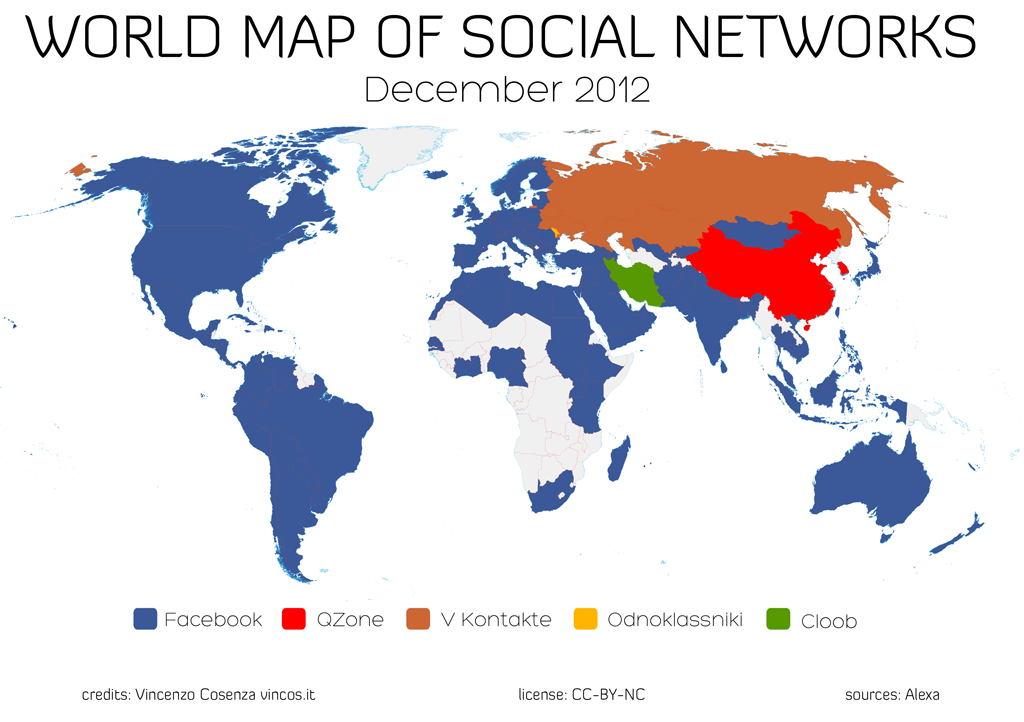
Check out Vincos Blog tracking world map of social networks.  It shows the past few years trend as Facebook becoming the de facto standard social network globally.  Only countries where Facebook is not the number one social network by activity are mostly places where geo-political issues are preventing the open network access, China, Russia and Iran.

Facebook Blue is spreading.
One exception? South Korea.
Will South Korea be the harbinger of life after Facebook?
Source: http://vincos.it/world-map-of-social-networks/

What does this mean to enterprise?

Tuesday, December 25, 2012

Product Management: Fear the unknown competitors

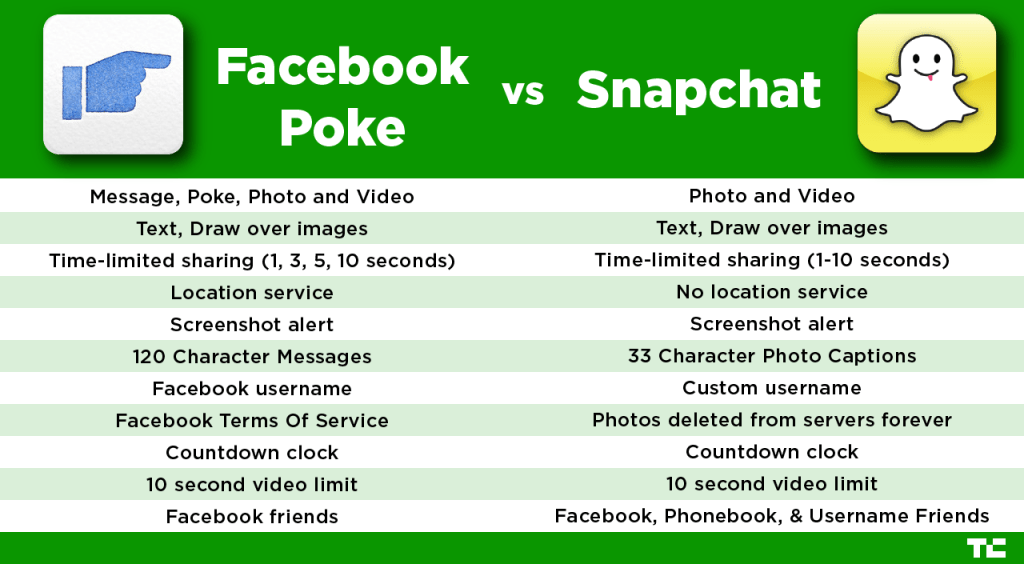
After reading Ben Parr's piece Why startups shouldn't be afraid of Facebook cloning them, I thought about the topic a little bit.  I agree with Parr's observation.  Facebook jumping in and cloning the app should not be a death sentence to a startup.  If anything, it should be seen as a validation that the idea is interesting and there is that much more potential for the market.

The reason is multiple fold.  The main one is that a big company like Facebook will not focus on single application idea because it's just too small and unproven to move Facebook's needle.  It means two things.  One, Facebook has other bread-earning business that they cannot let go, and two, although Facebook touts moving fast and breaking things, it is not going to be as fast as the laser-focused startup of a single team.


Facebook Poke is not the death sentence for Snapchat.
Snapchat should focus on its customers and building its roadmap.
Source: http://techcrunch.com

Friday, December 21, 2012

Will Facebook $1 message work?

Facebook has been undergoing transformation.  Transformation from privately held company to publicly traded company.  It also means going from get-bigger-user-base game to start-making-money game.  Facebook seems to be on a roll to churn out a new monetization idea every other week.  This week it is to pay $1 dollar to deliver a message to anyone in their inbox, even if they are not in your social graph (not counting the failed attempt to revise Instagram TOU).

For $1, Facebook will suspend the social graph messaging rule, and allow anyone to send direct message to my inbox.  Before we jump to a conclusion that Facebook have set out to sell the user data for the highest bidder, let's see how it might work.

$1 message means people like Zuckerberg will have lot more spams in their inbox.
That may work for Zuckerberg, but not for other high profile users.
Source: http://cdn.ph.upi.com

Tuesday, December 18, 2012

Instagram needs to make money

It's no secret that Instagram has been moving closer to seriously exploring the ways to generate revenue.  Ever since Instagram has been acquired by Facebook just on its way to going IPO, Instagram went from a 2-year-old company without any revenue stream to publicly traded company over a weekend.  Undoubtedly Instagram must be getting lot of pressure within Facebook to justify its $1 billion price tag by creating potential return on investment.

So it is understandable to see Kevin Systrom putting out a very aggressive Terms of Use (TOU) revision to users.  The language in the TOU suggested that Instagram can not only feature ads that are not marked as ads, but also can sell the right to use user's photos to third party sites.  Now Instagram user community has protested to the new terms, Systrom wrote a blog post backing down on selling the user's photos.  But it still retained a right to feature ads without clearly marking them as ads.

A photo of Instagram's TOU with Instagram's Earlybird filter.
I don't think I have to worry about my privacy on that one.
Source: http://instagram.com/p/TaCdC9Pekm/

Here is a fact.  Instagram needs to figure out make money, and do it fast.

Friday, December 14, 2012

Fade out of friction-less sharing

Guardian is quietly shutting down its Facebook social reader app.  If you remember, social reader app is the app that shares what you are reading with your friends automatically.  It's akin to tracking every article that you read through social reader app, and publishing the log to all your friends.  When it first started, I posted my criticism about this "friction-less sharing."

After about a year of experimenting, Guardian is ending the social reader app program.  The reason is obvious.  As GigaOM reported, it's because Guardian realized that 1) they didn't control how their content was delivered to their end users, and 2) user experience happened all within Facebook even when user is reading a Guardian content.

At one point Facebook social reader was generating more referral than Google.
Source: http://www.insidefacebook.com


And it came crashing down when Facebook stopped showing
the spammy social reading posts on our news feed.
Source: http://gigaom.com/

Wednesday, November 28, 2012

KQED: Facebook and Online Privacy

KQED Forum had a discussion around Facebook and Online Privacy this morning with Kara Swisher, Laura Sydell, and Marc Rotenberg.  The main question was whether Facebook's changing the user privacy policy to share user data with third party sites was going too far.  Although Facebook has been asking users to vote, but it's effectively abolishing the voting process while Facebook is looking to sell user data to its ad network affiliates.

You can listen to the full program.


It is interesting to listen to panelists raising all kinds of privacy questions:

Saturday, November 17, 2012

Facebook to marketers: We'll show your ROI

Q: Which one of the following is not a communication tool?

  1. Email
  2. Facebook
  3. Skype
  4. Google Search
Answer is obvious.  Anyone who used the tools would identify Google Search.  And that has been the biggest challenge that Facebook has been dealing with.  Most users think of Facebook as communication tool, much like email and instant messaging.  Facebook users visit facebook.com to stay in touch with friends and keep up with what their friends are up to.

Hence advertising on Facebook did not work as well as Google Search.  People are looking for something when they visit google.com.  It's the perfect opportunity to pitch related products that might solve the people's problem.

Sunday, October 7, 2012

Facebook is like a free printing press for all

Facebook released their ad created by Wieden & Kennedy last week.  It compares Facebook to chairs, and emotionally connects with audience that Facebook is more than just a website and mobile app that people use to communicate with friends.

It's shot and edited beautifully.  It eloquently explains what Facebook wants to become.  Yet I thought it over-reached a bit when it tried to account for the reason why we want to connect with others because of dark universe.  If you haven't watched the video, here it is:


Once the Facebook ad got released, it immediately created lot of discussions and reactions from many.  And, thanks to social media, meme machine got in to action and started publishing parodies.  Here is the one that compares Facebook to toilets:

Thursday, October 4, 2012

How Facebook hopes to make money off of 1 billion users

Facebook has reached 1 billion user milestone in September.  Mark Zuckerberg made a brief announcement on Facebook to mark this occasion.  To put this number in perspective, there are about 7 billion global population, and about 32% of them are on Internet.  That's about 2.2 billion people who are on Internet.  This means if you pick an Internet user at random, you'll have about 45% chance that user is a Facebook user.

With this new milestone, Facebook has been announcing their new ways to make money: make money by asking users to pay for services.  Promoted personal post is one such example.  Under $50 gift to share with people is another.

Now there is a way for you to promote your own post to get your friends' attention.
Source: http://www.blogcdn.com/www.engadget.com/
I don't know whether these new monetization schemes are going to work with users.  But Facebook is demonstrating that they are not just looking at advertisement as their source of revenue, and I think they are doing the right thing.

Facebook's main strength is its user base.  As long as Facebook continues to serve user's need and remains as the social backbone of Internet, Facebook will have many chances to get the monetization model right.

Monday, October 1, 2012

Ideas are cheap. Here are a few for Facebook.

Facebook made a blog post about joint study with Datalogix showing that clicks don't really matter when it comes to Facebook ads.  What matters more instead, Brad Smallwood says, is number of times it's shown to unique users at optimal interval.

Facebook Director of Pricing and Measurement, Brad Smallwood, basically says
to trust Facebook and Datalogix because they know how ad works on Facebook.
Don't know you, but it doesn't sound like a winning strategy...
Source: http://7.mshcdn.com/
Here is the Facebook's problem.  Marketers are comparing Facebook ads with Google Adwords.  Although Facebook ads are in different category all together, marketers are used to dealing with and understands Google Adwords model.  The key difference between ads from two sites come from what users are looking for when they visit the sites.

Users come to Google to look for something, whereas users come to Facebook to catch up with their friends.  Many more users are open to discovering new things when they visit Google than Facebook.  As Susan Lyne summed it up, 'selling things on Facebook is like selling things in a bar.'

So here are some cheap ideas to solve this problem:

Thursday, September 27, 2012

Marketers are still unsure of Facebook

One quote caught my eyes the most when I scanned through my Twitter Timeline.

Selling things on Facebook is like selling things in a bar.

It was a statement by Gilt Chairman Susan Lyne.  Gilt was one of the early adopters to set up Facebook store, but the store was a flop.  It turned out that there were other marketers sharing similar sentiments about Facebook as advertisement platform.  Check out more damning quotes from this BusinessInsider article.

Facebook users are logging on to connect with friends, family and people around them.  But when it comes to discovering a new product or finding a good deal on products, Facebook users are not responding to them the same way as Google ads.

Sunday, September 23, 2012

Facebook is moving away from "passive sharing"

I'm sure you've seen it around on Facebook.  So-called passive sharing (also known as frictionless sharing) is when a Facebook application shares your activity, specially reading an article or watching a video, with all your friends automatically.  It was announced at F8 2011, and has been touted as a new way to share your activities.

At 2012 Online News Association, Liz Heron tweeted that Andy Mitchell from Facebook said passive sharing is something that Facebook is moving away from.  A good riddance.


Friday, September 21, 2012

How does friends reporting friends make a better Facebook?

Facebook started to prompt users to report fake accounts used by their friends.  By now most people know that Facebook wants to become a social network where real name is used.  The reason is simple one.  Facebook generates its revenue by serving ads to users, and wants real users who connect with their real friends so that more information can be collected regarding each user.

Real identity makes sense for Facebook.  But what is in it for user?  How does Facebook become a better social network by turning in a friend who uses Facebook with pseudonyms?

@chapeaudefee reported the screenshot.
I wonder how many users actually respond with 'yes'.
Source: https://pbs.twimg.com/media/A3Mzyo3CEAAef3W.jpg